Guides
Respiratory Therapy Guides
Long-form teaching pages written for the bedside — each one cited, structured, and tied to the tools and references you’ll use alongside it.
Fundamentals
Breath Sounds & Lung Auscultation
A systematic approach to lung auscultation — the listening sequence, normal vesicular and bronchial sounds, and an adventitious-sounds table covering crackles, wheezes, rhonchi, stridor, and pleural rubs with their mechanisms and causes.
Respiratory System Anatomy & Physiology
How the respiratory system is built and how it moves air: the conducting and respiratory zones, the alveolar-capillary membrane and surfactant, the pleura, the muscles of ventilation, and the pressures that drive every breath.
Gas Exchange & Oxygen Transport
How oxygen moves from alveolus to mitochondria: diffusion across the alveolar-capillary membrane, the oxyhemoglobin dissociation curve and its shifts, oxygen content and delivery, and how carbon dioxide is carried back.
Ventilation-Perfusion (V/Q) Matching
Why matching airflow to blood flow is the key to gas exchange: the normal V/Q ratio and its regional gradient, dead space versus shunt, hypoxic pulmonary vasoconstriction, and the five mechanisms of hypoxemia.
Control of Breathing
How the body regulates ventilation breath to breath: the medullary and pontine centers, central and peripheral chemoreceptors, the dominant role of CO₂ and pH, and the hypoxic drive that matters in chronic CO₂ retention.
Respiratory Patient Assessment
A systematic bedside respiratory assessment: history and the cardinal symptoms, then inspection, palpation, percussion, and auscultation, plus the vital signs and work-of-breathing signs that flag a deteriorating patient.
ABG & Acid-Base
ABG Interpretation Basics
A systematic five-step method for arterial blood gas interpretation — pH, PaCO₂, HCO₃⁻, compensation, and oxygenation — with worked examples and the patterns RTs see at the bedside.
Acid-Base Compensation Explained
How lungs and kidneys compensate for acid-base disorders — Winter's formula, the expected-compensation rules, and how to catch a hidden second disorder.
Venous & Capillary Blood Gases
When a venous or capillary gas can stand in for an arterial sample — how VBG and CBG values correlate with the ABG, where the agreement breaks down, and the clinical situations that still demand an arterial stick.
Mixed Acid-Base Disorders
Recognizing when two or three acid-base disturbances coexist — using the expected-compensation windows, the anion gap, and the delta ratio to uncover a second or third process the pH alone conceals.
Oxygen Therapy
Oxygen Delivery Devices
Low-flow, high-flow, and reservoir oxygen devices compared — nasal cannula, simple and Venturi masks, partial and non-rebreathers, and HFNC — with flow rates, approximate FiO₂, and the bedside rules RTs use to pick the right one.
Oxygen Titration & Escalation
How to set SpO₂ targets, climb the oxygen escalation ladder, and recognize when a patient needs to step up — with the correct mechanism behind oxygen-induced hypercapnia in COPD and why you never withhold oxygen from a hypoxemic patient.
High-Flow Nasal Cannula (HFNC) Therapy
How heated, humidified high-flow nasal cannula works and where it fits — the flow, FiO₂, dead-space washout, and modest PEEP it delivers, the indications, the ROX index for tracking success, and how to set it up and wean it.
Oxygen Toxicity & the Hazards of Oxygen Therapy
Oxygen is a drug with real harms — pulmonary and CNS oxygen toxicity, absorption atelectasis, oxygen-induced hypercapnia in COPD, retinopathy of prematurity, and fire risk — and the targeted SpO₂ strategy that avoids them.
Mechanical Ventilation
Ventilator Modes Explained
How the main ventilator modes work — AC/VC, AC/PC, SIMV, PSV, PRVC, APRV, and CPAP — built on the trigger, limit, and cycle framework, with watch-outs.
Initial Ventilator Settings
Set mode, tidal volume, rate, FiO₂, and PEEP for adult mechanical ventilation — starting from predicted body weight, with first-ABG titration logic.
Noninvasive Ventilation Basics
When to use CPAP vs bilevel NIV, starting pressures, contraindications, and the 1–2 hour reassessment that decides success or intubation.
Weaning & Spontaneous Breathing Trials
Run a spontaneous breathing trial — the daily readiness screen, SBT mechanics and failure criteria, RSBI, and why passing the SBT isn't extubation.
Ventilator Waveforms & Graphics
Read ventilator scalars and loops at the bedside — pressure, flow, and volume over time plus the P-V and F-V loops — and recognize the patterns they show: peak-vs-plateau (resistance vs compliance), auto-PEEP, leaks, and flow starvation.
Airway Management
Endotracheal Intubation
The RT's role in endotracheal intubation — preparation and equipment, preoxygenation, assisting the laryngoscopy, gold-standard tube confirmation with waveform capnography, securing, and the immediate post-intubation checks.
Rapid Sequence Intubation (RSI)
The seven Ps of rapid sequence intubation — preparation through post-intubation management — with the induction agents and paralytics, the RT's preoxygenation and confirmation role, and the common pitfalls.
Airway Suctioning
Endotracheal and tracheostomy suctioning the right way — open vs closed systems, suctioning only when indicated, catheter size and pressure limits, hyperoxygenation, and the complications to anticipate.
Extubation & Post-Extubation Airway Care
The airway side of extubation — the cuff-leak test, the extubation procedure, post-extubation stridor and laryngeal edema, racemic epinephrine, and when reintubation or NIV is the right call.
Difficult Airway Assessment
Predicting and preparing for the difficult airway — the LEMON and 3-3-2 assessment, Mallampati classes, the mask and supraglottic difficulty mnemonics, and where video laryngoscopy and rescue devices fit.
Critical Care
Shock Recognition & Management
The four categories of shock — hypovolemic, cardiogenic, distributive, and obstructive — with their hemodynamic profiles, the RT's role in oxygen delivery and airway support, and the bedside pitfalls.
Sepsis & Septic Shock for RTs
Sepsis-3 definitions, the Surviving Sepsis Campaign bundle, and the respiratory therapist's role — recognizing sepsis-induced respiratory failure and ARDS, supporting oxygenation, and tracking lactate.
Hemodynamic Monitoring Basics
The hemodynamic numbers RTs work alongside — MAP, CVP, PCWP, cardiac output and index, SVR, and mixed venous saturation — what they mean, how oxygen delivery ties in, and the bedside pitfalls.
Sedation, Analgesia & Delirium in the ICU
The PADIS approach to the ventilated patient — analgesia first, light sedation, avoiding benzodiazepines, the RASS and CAM-ICU tools, and the ABCDEF bundle that pairs awakening with breathing trials.
Prone Positioning for ARDS
When and how to prone the ARDS patient — the P/F < 150 threshold, the PROSEVA evidence for ≥16 hours a day, the physiology of recruitment, and the RT's airway-first role through the turn.
Emergency Respiratory Care
Acute Respiratory Failure
When the lungs can no longer oxygenate or ventilate - the difference between Type I (hypoxemic) and Type II (hypercapnic) failure, what causes each, how to recognize impending failure, and the escalation ladder from oxygen to HFNC to NIV to intubation.
Cardiopulmonary Resuscitation: Airway & Ventilation
The respiratory therapist in the adult code - high-quality CPR, the airway and ventilation sequence, the right ventilation rates with and without an advanced airway, how capnography confirms the tube and tracks CPR quality and ROSC, and why hyperventilation kills.
Carbon Monoxide Poisoning & Smoke Inhalation
The poisoning a pulse oximeter cannot see - how carbon monoxide binds hemoglobin and left-shifts the curve, why SpO₂ reads falsely normal, the role of co-oximetry and 100% oxygen, and the airway threat of smoke inhalation and inhalation injury.
Tension Pneumothorax Recognition & Management
A breath-by-breath emergency - how air trapped under pressure collapses the lung and shifts the mediastinum, the signs that separate a simple from a tension pneumothorax, why it is a clinical (not radiographic) diagnosis, and the needle decompression and chest tube that fix it.
Anaphylaxis & Acute Airway Emergencies
When the airway is closing - how to recognize anaphylaxis fast, why intramuscular epinephrine is the immediate first-line drug, the adjuncts (oxygen, nebulized epinephrine, bronchodilators, antihistamines, steroids), and the airway plan when angioedema threatens to obstruct.
Pulmonary Diseases
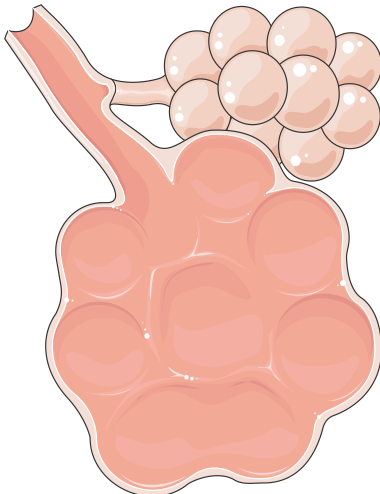
COPD Exacerbation Management
How RTs assess and manage an acute COPD exacerbation — controlled oxygen to 88–92%, combined SABA/SAMA bronchodilators, steroids, antibiotics, and NIV for hypercapnic respiratory acidosis.
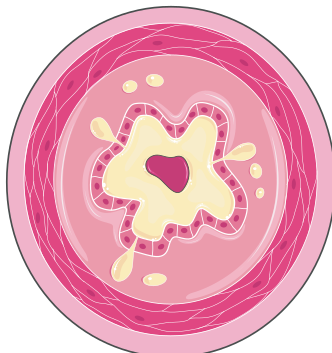
Asthma Exacerbation Management
Severity assessment and treatment of an acute asthma exacerbation — high-dose SABA, ipratropium, early steroids, oxygen, and the ominous signs of impending respiratory failure that a normal CO₂ can hide.
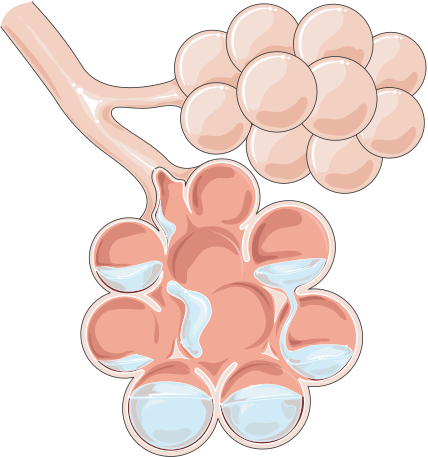
ARDS Basics
The Berlin definition, pathophysiology, and lung-protective ventilation of ARDS — 6 mL/kg of predicted body weight, plateau ≤ 30 cmH₂O, permissive hypercapnia, PEEP titration, and prone positioning.
Pneumonia: CAP, HAP, and VAP
Clinical guide to community-acquired, hospital-acquired, and ventilator-associated pneumonia: pathophysiology, severity scoring with CURB-65, assessment findings, and RT management priorities including oxygenation targets and VAP prevention.
Pulmonary Embolism
Pulmonary embolism obstructs the pulmonary arterial circulation, creating alveolar dead space, V/Q mismatch, and acute RV strain. Covers Virchow's triad, the PERC rule, capnography changes, risk stratification, and RT priorities for massive and submassive PE.
Pneumothorax and Chest Tube Management
Covers the full pneumothorax spectrum from primary spontaneous to tension, plus three-chamber drainage system management, air-leak troubleshooting, and ventilator barotrauma prevention for respiratory therapists.
Cystic Fibrosis
A clinical guide to cystic fibrosis covering CFTR pathophysiology, sweat chloride diagnosis, daily airway clearance techniques, the correct inhaled therapy sequence, and disease-modifying CFTR modulators for respiratory therapists.
Bronchiectasis
A clinical guide to non-CF bronchiectasis covering the vicious cycle of infection and inflammation, HRCT diagnosis with the signet-ring sign, daily airway clearance techniques, mucoactive therapy, and antibiotic strategies for stable disease and exacerbations.
Interstitial Lung Disease and Pulmonary Fibrosis
Interstitial lung disease inflames and scars the lung interstitium, producing a restrictive defect with impaired diffusion. Covers IPF, the UIP pattern, oxygen therapy, antifibrotic awareness, and PFT interpretation for respiratory therapists.
Pulmonary Hypertension
Pulmonary hypertension is elevated pressure in the pulmonary circulation that strains and ultimately fails the right ventricle. Covers the WHO five-group classification, hemodynamic definition, the diagnostic role of right heart catheterization, and why group-specific therapy matters.
Aerosol Therapy & Pharmacology
Aerosol Drug Delivery
How aerosolized drugs reach the lungs — respirable particle size, the deposition mechanisms, and the pMDI, DPI, nebulizer, and soft-mist devices with the technique each demands and how to match one to the patient.
Bronchodilators
The two bronchodilator families RTs give every shift — β₂-agonists (SABA and LABA) and antimuscarinics (SAMA and LAMA) — with mechanism, the rescue-vs-maintenance split, side effects, and what to monitor.
Inhaled Corticosteroids & Controllers
The controller side of inhaled therapy — inhaled corticosteroids, ICS/LABA combinations, and leukotriene modifiers — how they work over time, the rinse-and-spit that prevents thrush, and why they are never rescue drugs.
Mucoactive Agents
The drugs that thin, hydrate, or break down secretions — N-acetylcysteine, dornase alfa, hypertonic saline, and expectorants — how each works, the bronchospasm cautions, and why they pair with airway clearance.
Inhaled Pulmonary Vasodilators & Specialty Aerosols
The specialty inhaled agents RTs manage in the ICU — inhaled nitric oxide and prostacyclins, inhaled antibiotics, and racemic epinephrine — with how each works, the monitoring, and the withdrawal cautions.
Pulmonary Function Testing
Spirometry Basics
The foundation of pulmonary function testing - what FEV₁, FVC, and the FEV₁/FVC ratio measure, how a good effort is coached and judged (ATS/ERS acceptability and repeatability), and how the ratio separates an obstructive from a restrictive pattern.
Interpreting Pulmonary Function Tests
A systematic way to read a PFT - start with the FEV₁/FVC ratio to find obstruction, use the FVC and TLC to find restriction, grade severity by percent predicted, check bronchodilator response, and let DLCO narrow the cause.
Flow-Volume Loops
Reading the spirometry loop at a glance - the normal shape, the scooped expiratory limb of obstruction, the tall narrow loop of restriction, and the flattened plateaus that flag fixed and variable upper-airway obstruction.
Diffusing Capacity (DLCO)
How well gas crosses the alveolar-capillary membrane - what the single-breath DLCO measures, why carbon monoxide is used, the diseases that lower it (emphysema, interstitial disease, pulmonary vascular disease, anemia) and raise it, and the hemoglobin correction.
Bronchoprovocation & Bronchodilator Response
Proving airway reactivity when spirometry is normal - the bronchodilator reversibility criteria (12% and 200 mL), the methacholine challenge and its PC20, the role of exercise challenge, and how these tests confirm or exclude asthma.
Labs & Diagnostics
Complete Blood Count (CBC) for the Respiratory Therapist
How respiratory therapists read the complete blood count — the white count and differential, hemoglobin and hematocrit and their link to oxygen-carrying capacity, and the platelet count before invasive procedures.
Electrolytes & the Basic Metabolic Panel in Respiratory Care
The basic metabolic panel through a respiratory lens — sodium, potassium, chloride and bicarbonate, the anion gap, and how potassium, phosphate, and magnesium affect respiratory muscle strength and weaning.
Lactate & Tissue Oxygenation
What a lactate tells the respiratory therapist — anaerobic metabolism and the oxygen-delivery/demand balance, type A versus type B lactic acidosis, the sepsis thresholds, and lactate clearance as a resuscitation target.
Cardiac & Pulmonary Biomarkers: BNP, Troponin, and D-dimer
The biomarkers that help separate a cardiac from a pulmonary cause of dyspnea — BNP and NT-proBNP for heart failure, troponin for myocardial injury and right-heart strain, and D-dimer for venous thromboembolism.
Sputum Gram Stain & Respiratory Cultures
Reading the respiratory micro lab — judging specimen quality on the Gram stain, recognizing the common pathogens by clinical setting, and understanding the culture, sensitivity, and acid-fast workup that guide antibiotic therapy.
Chest X-Ray Interpretation Basics for RTs
A respiratory therapist's systematic approach to the chest radiograph — confirming tube and line placement after intubation, and recognizing the common patterns of consolidation, atelectasis, pneumothorax, effusion, and pulmonary edema.
Coagulation Studies Before Respiratory Procedures
The coagulation labs to check before an invasive respiratory procedure — PT/INR, aPTT, and the platelet count — what they measure, the anticoagulants that affect them, and the bedside thresholds for arterial puncture, bronchoscopy, and chest tubes.
Co-oximetry & Dyshemoglobinemias
Why a pulse oximeter cannot see carbon monoxide or methemoglobin, and how laboratory co-oximetry measures the true hemoglobin species — carboxyhemoglobin, methemoglobin, and sulfhemoglobin — to expose a saturation gap and guide treatment.
Point-of-Care Testing & Blood Gas Quality Assurance
The point-of-care testing respiratory therapists own — bedside blood gas and co-oximetry analyzers — and the quality assurance that keeps results trustworthy: calibration, quality control, proficiency testing, and avoiding pre-analytic errors.
Pleural Fluid Analysis & Light’s Criteria
Making sense of a thoracentesis result — Light's criteria for separating a transudate from an exudate, and the pleural fluid pH, glucose, LDH, and cell counts that identify a complicated effusion needing drainage.
ECG Rhythm Recognition
A systematic rate-rhythm-axis approach to the ECG for respiratory therapists, then the board-tested rhythm set — from sinus tach and atrial fibrillation to VT, VF, PEA, the AV blocks, and paced rhythms.
Sleep Medicine
Obstructive Sleep Apnea: Pathophysiology & Management
Obstructive sleep apnea (OSA) causes repetitive upper-airway collapse during sleep, producing intermittent hypoxemia, cortical arousals, and serious cardiovascular consequences. Learn the pathophysiology, AHI severity criteria, STOP-BANG screening, and CPAP-first management strategy.
Polysomnography & Sleep Study Essentials
Polysomnography (PSG) is the gold-standard overnight multichannel recording used to diagnose sleep-disordered breathing. Learn how channels are scored, how to classify events, and what the AHI, RDI, and REI mean in practice.
CPAP & BiPAP Titration
How respiratory therapists titrate CPAP, APAP, and bilevel (BiPAP) for obstructive sleep apnea — AASM protocol, interface selection, adherence targets, and common pitfalls.
Central Sleep Apnea & Cheyne-Stokes Respiration
Central sleep apnea (CSA) occurs when the respiratory drive pauses — no effort, no airflow. Learn the key types, Cheyne-Stokes respiration in heart failure, ASV contraindications (SERVE-HF), and the RT's treatment priorities.
Obesity Hypoventilation Syndrome (OHS)
Obesity hypoventilation syndrome (OHS) is defined by obesity (BMI ≥30 kg/m²), daytime chronic hypercapnia (awake PaCO₂ ≥45 mm Hg), and sleep-disordered breathing after other causes of hypoventilation have been excluded. Learn pathophysiology, ABG findings, PAP therapy priorities, and board exam pearls.
Neonatal & Pediatric
Neonatal Respiratory Distress Syndrome (RDS)
Surfactant-deficient lung disease of the premature newborn - why RDS happens, how it looks on exam and X-ray, and the modern management ladder of antenatal steroids, early CPAP, and surfactant (INSURE and LISA).
Neonatal Resuscitation Essentials
The delivery-room sequence every RT should own - the Golden Minute, the initial steps, effective positive-pressure ventilation and MR SOPA, when to escalate to compressions and epinephrine, and how oxygen is targeted in the newborn.
Pediatric Respiratory Assessment
How children differ from adults - the anatomic and physiologic features that make them desaturate faster - plus the signs of respiratory distress, normal vitals by age, and the progression from distress to failure to arrest.
Bronchiolitis (RSV) Management
The most common lower-respiratory infection in infants - how RSV bronchiolitis presents, the evidence-based supportive approach (and what not to do), the role of high-flow nasal cannula and CPAP, and the apnea and red-flag signs that demand escalation.
Croup & Pediatric Upper Airway Obstruction
Stridor in a child - the spectrum of upper-airway obstruction from viral croup to epiglottitis and bacterial tracheitis, how to grade severity, and the management that turns it around: keep the child calm, racemic epinephrine, and corticosteroids.
Transport Respiratory Care
Intrahospital Transport of the Ventilated Patient
How respiratory therapists safely move a mechanically ventilated patient within the hospital — team, equipment, monitoring, and the adverse events to prevent in transit.
Interfacility Transport: Choosing Ground vs Air
How transport teams choose between ground ambulance, rotor-wing, and fixed-wing for interfacility transfer — distance, time, weather, acuity, and the respiratory trade-offs of each mode.
Transport Ventilator Management
How transport ventilators differ from ICU ventilators, how to maintain settings continuity in transit, and why drive-gas type drives your oxygen math.
Altitude Physiology & Gas Laws in Transport
The gas laws behind altitude physiology — Boyle and Dalton — and what they mean for trapped gas, oxygenation, and pre-flight preparation during air transport.
Oxygen Supply Management During Transport
Sizing and managing the oxygen supply for transport — cylinder factors, the duration formula, safe residual pressure, drive-gas consumption, and reserve.
Physiologic Stresses of Transport
The physiologic stressors of transport — hypoxia, barometric change, thermal, humidity, noise, vibration, acceleration, and fatigue — and how respiratory therapists mitigate each.
Neonatal & Pediatric Transport
Specialized neonatal and pediatric transport — the transport incubator, thermoregulation as a respiratory priority, airway security, and oxygen targeting in the preterm infant.
Airway Management During Transport
Securing and confirming the airway for transport — when to intubate before departure, continuous capnography, the DOPE check, and cuff management at altitude.
Pre-Transport Assessment & Preparation
A systematic pre-transport workup — risk-benefit and communication, the ABC-plus-equipment package, stabilizing before departure, and the checklist that prevents adverse events.
Monitoring During Transport
Monitoring the patient in motion — the minimum standard, why capnography leads in transport, and how vibration, noise, and motion degrade what you can trust.
Clinical Skills
Arterial Blood Gas Sampling
How to obtain an arterial blood gas sample — site selection, the modified Allen test, technique, and the pre-analytic errors that ruin a result.
Pulse Oximetry & Co-oximetry
How pulse oximetry works and where it fails — the two-wavelength principle, accuracy limits, and why carbon monoxide and methemoglobin demand co-oximetry.
Chest Physiotherapy & Airway Clearance
Chest physiotherapy and airway clearance techniques — postural drainage, percussion, PEP, oscillatory devices, and HFCWO — with indications and key contraindications.
Incentive Spirometry & Lung Expansion Therapy
Incentive spirometry and lung expansion therapy for atelectasis — correct sustained-maximal-inspiration technique, indications, and when to use IPPB or CPAP instead.
Manual Resuscitation with a Bag-Valve-Mask
Manual resuscitation with a bag-valve-mask — bag types, mask seal, oxygen delivery, rate and volume, and avoiding the harm of over-ventilation.
Tracheostomy Care
Routine and emergency tracheostomy care — inner cannula and stoma care, cuff pressure, humidification, securing the tube, and the decannulation emergency.
Humidity & Bland Aerosol Therapy
Humidity and bland aerosol therapy — humidifiers versus aerosol generators, when a bypassed airway must be humidified, and the bronchospasm risk of hypertonic saline.
Bedside Respiratory Measurements
Bedside respiratory measurements that guide weaning — vital capacity, MIP/NIF, MEP, minute ventilation, and the rapid shallow breathing index, with their thresholds.
Sputum Induction & Specimen Collection
Sputum induction and specimen collection — expectorated versus induced samples, hypertonic-saline technique, specimen quality, and airborne precautions for suspected TB.
Infection Prevention in Respiratory Care
Infection prevention in respiratory care — hand hygiene, transmission-based precautions, aerosol-generating procedures, equipment processing, and the VAP bundle.
Equipment Reprocessing & Disinfection
How respiratory care equipment is reprocessed — the Spaulding classification, the cleaning-disinfection-sterilization hierarchy, and the specific agents and methods (glutaraldehyde, OPA, ethylene oxide, autoclave, pasteurization) used to make reusable devices safe between patients.
Respiratory Care Safety: Fire, Electrical & Cylinder Hazards
The safety hazards unique to respiratory care and how to control them — the oxygen-enriched fire triangle and the RACE and PASS responses, electrical macroshock versus microshock and leakage current, and safe compressed-gas cylinder handling and storage.
RT Career & Professional Practice
The RT Credentialing Pathway
The path to becoming a credentialed respiratory therapist — graduating from an accredited program, the entry exam and its two cut scores, the clinical simulation exam, and how the CRT and RRT are earned.
Respiratory Therapy Specialty Credentials
The specialty credentials a respiratory therapist can earn beyond the RRT — adult critical care, neonatal/pediatric, sleep, pulmonary function, and asthma education — including which require the RRT and how to qualify for each.
RT Licensure & Scope of Practice
How respiratory therapists are licensed to practice and what defines their scope — state licensure requirements, the relationship between credential and license, and where scope of practice comes from.
Respiratory Therapist Roles & Work Settings
Where respiratory therapists work and what they do — acute care, critical care, neonatal/pediatric, sleep, pulmonary function, home care, transport, education, and leadership roles.
Professional Organizations in Respiratory Care
The organizations that shape respiratory care — the professional association, the credentialing board, the program accreditor, and state societies — and the distinct role each one plays.
Ethics & Professionalism in Respiratory Care
The ethical foundation of respiratory care — autonomy, beneficence, nonmaleficence, justice, and the professional duties of veracity, fidelity, and confidentiality — applied to real bedside dilemmas.
Evidence-Based Practice in Respiratory Care
How respiratory therapists turn research into bedside care — the steps of evidence-based practice, the hierarchy of evidence, and how clinical practice guidelines and protocols are built on it.
Medical Documentation & Charting
How respiratory therapists document care defensibly — what to chart, the common note formats, the legal principle that not charted means not done, and the abbreviations to avoid.
Therapeutic Communication & Patient Education
How respiratory therapists communicate therapeutically and teach patients effectively — active listening, health literacy, the teach-back method, and structured team communication.
Continuing Education & Credential Maintenance
How respiratory therapists keep their credentials and licenses current — the credential maintenance cycle, continuing education credits, and license renewal requirements.